Timeless Wisdom for Modern Minds: Aristotle’s Golden Mean in Today’s World
Picture This: The Pursuit of Balance
Picture this: You’re juggling work deadlines, family responsibilities, and the relentless push to “do more.” Maybe you’ve tried productivity hacks, mindfulness apps, or even the latest self-help bestseller—yet lasting ease and clarity remain elusive. In a world that rewards extremes—work harder, speak louder, push further—it’s easy to lose sight of the steady centre. But what if the secret to sustainable excellence isn’t on the edge, but in the artful middle?
The Modern Mindset Movement
If you practise Neuro-Linguistic Programming (NLP), you already understand the power of models, frames, and linguistic patterns to dismantle limiting beliefs and install new, empowering strategies.
For those unfamiliar with NLP, it is a discipline that examines the link between our thoughts, language, and behaviours. By learning to recognise and adjust these patterns, people can free themselves from self-imposed limitations and create more positive outcomes in their lives.
Ancient Wisdom, Modern Relevance
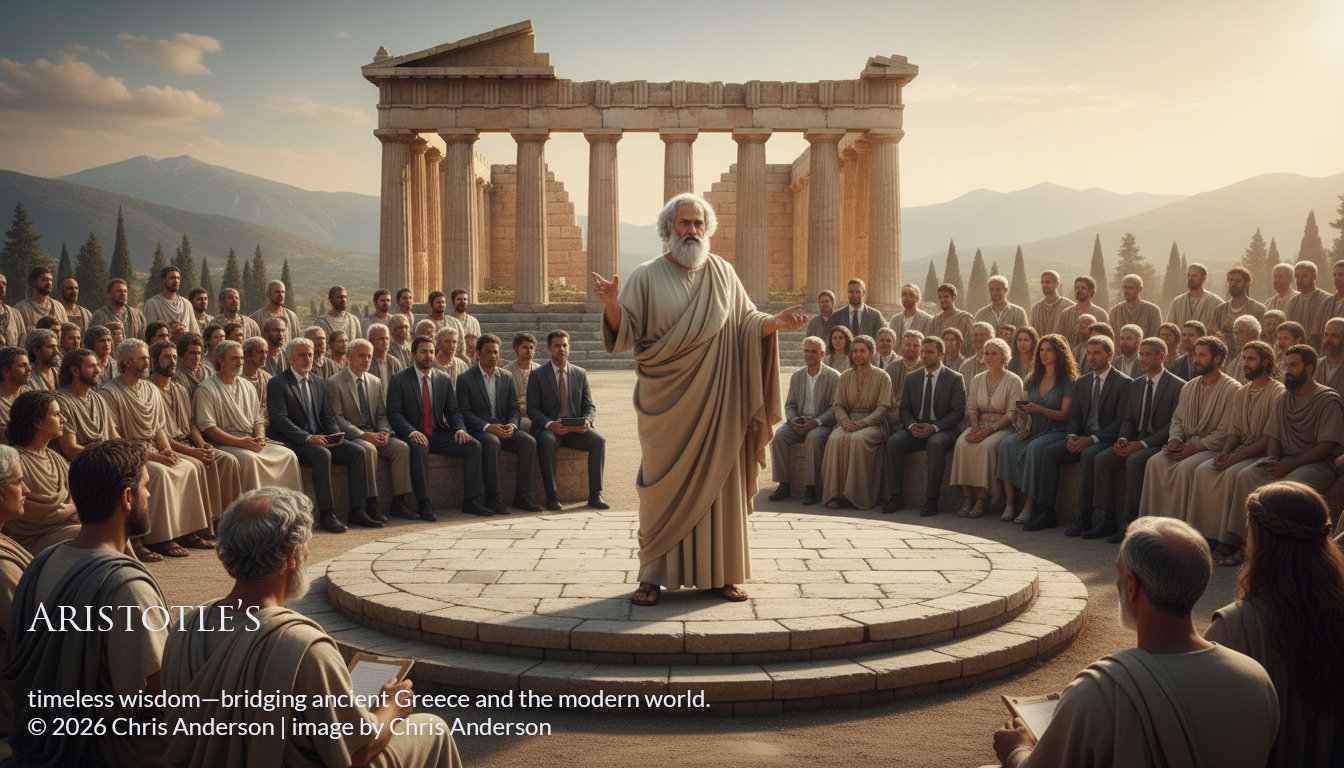
Now consider this: one of the most profound frameworks for shaping human thought and behaviour wasn’t conceived in a Silicon Valley startup or unveiled at a TED Talk, but in an Athenian lecture hall over 2,300 years ago. Aristotle’s concept of the Golden Mean reminds us that the search for balance and excellence is not a modern trend, but an enduring human pursuit. Long before NLP techniques emerged, people sought wisdom in this principle—using it to guide their choices, cultivate resilience, and strive for harmony in daily life. This ancient blueprint for personal growth continues to inspire and inform our efforts today, creating a bridge between classical philosophy and contemporary mindset mastery.
Meet Aristotle: The Original Mindset Coach
Born in 384 BCE, Aristotle was more than a philosopher; he was a scientist, teacher, and lifelong learner. His studies covered everything from biology to ethics, but his greatest legacy might be his model for living well: the Golden Mean. In Aristotle’s view, virtue wasn’t about denial or bland moderation. It was about finding the dynamic “right amount”—for example, courage as the balanced path between over-caution (holding back too much) and impulsivity (acting without considering consequences), generosity as the space between excessive saving and over-giving, and confidence as the healthy middle ground between self-doubt and over-focus on self-image.
Beyond Positive Intention: Finding the Virtuous Intention
In NLP, we operate from a core presupposition: every behaviour has a positive intention. Even seemingly negative behaviours like procrastination or anger have a purpose—perhaps to protect us from perceived failure or to signal a boundary crossed.
Aristotle takes this crucial step further. He asks: "Yes, but what is the most resourceful expression of that positive intention?"
He called this resourceful expression virtue—the excellence of character that leads to eudaimonia (a state of human flourishing we might call "being in an ultimate, congruent state of excellence").
His genius was in mapping it out. For any situation, virtue is not found at the extremes, but perfectly balanced in the middle—the Golden Mean.
Modern-Day Examples of the Golden Mean
Communication at Work: Imagine you’re in a meeting and disagree with a proposal. One extreme is staying silent (over-caution or withholding your perspective). The other extreme is interrupting or dismissing others (over-assertiveness). The Golden Mean is to express your viewpoint clearly and respectfully, while also listening to the needs and perspectives of others without judgment. This builds trust, influence, and collaboration.
In Relationships: Consider a moment when your partner or friend makes a mistake. One extreme is ignoring the issue (avoidance or under-engagement). The other extreme is overreacting or being overly critical (over-control). The Golden Mean is to address the situation calmly and constructively, sharing your feelings with compassion while also listening to the other person’s needs and perspectives without judgment. This creates a deeper understanding and connection.
Self-Growth: Suppose you make a mistake at work or in a personal project. One extreme is harsh self-criticism (over-focus on flaws). The other extreme is dismissing the mistake entirely (avoiding responsibility). The Golden Mean is to acknowledge what happened, reflect on what you can learn, and encourage yourself to grow—listening to your own needs and feelings without judgment. This supports resilience and sustainable growth.
Health and Well-being: You’re starting a new exercise routine. One extreme is pushing yourself to exhaustion every day (over-exertion). The other extreme is skipping workouts completely (inactivity or under-engagement). The Golden Mean is to find a sustainable routine that challenges you without causing burnout and allows for both progress and rest. Listen to your body’s signals and needs without self-judgment, adjusting as needed.
Empathy in Everyday Life
Empathy—the ability to understand and share others' feelings—is a key part of finding the Golden Mean in any relationship or interaction, not just in formal leadership roles. It sits between indifference (not caring about others’ perspectives) and over-involvement (losing your own boundaries in trying to help). Practising empathy means listening deeply and responding with care, while also honouring your own needs and limits.
With Family or Friends: When a loved one is upset, empathy helps you support them without taking on their emotions as your own or dismissing their experience.
At Work: Understanding a colleague’s viewpoint can help you collaborate more effectively, resolve conflicts, and build trust.
With Yourself: Self-empathy—listening to your own needs and feelings without harsh judgment—supports resilience and growth.
Empathy, when practised as a balanced response, enriches every aspect of life and is at the heart of meaningful connection.
Science Catches Up: Research on Balance and Wellbeing
Recent studies in psychology and neuroscience echo Aristotle’s intuition. Research shows that people who embrace dialectical thinking (holding two opposing ideas in mind) are more resilient and adaptable. Mindfulness practices, too, are all about finding the “middle path” rather than swinging from one emotional extreme to another.
A Harvard study on work-life balance concluded that those who consciously alternate between focused work and proper rest—rather than trying to “do it all”—report higher productivity and lower stress. It seems Aristotle’s map—the Golden Mean, his mental model for finding balance—still charts the best course.
Avoiding the Trap: The Golden Mean Isn’t Mediocrity
It’s a common misconception that balance means settling for less or never taking risks. The Golden Mean, however, is active and intentional. It requires discernment, courage, and regular self-reflection. It’s about choosing the right response for the situation, not defaulting to autopilot.
How to Apply the Golden Mean: Practical Steps
You don’t need to be a philosopher to apply this ancient wisdom. Begin with these steps:
Notice Your Extremes: Pay attention to moments of emotional intensity. Are you leaning toward avoidance or overreaction?
Define Balance: Ask yourself: What would a calm but clear response look like in this moment?
Make Small Adjustments: Progress, not perfection, is the goal. Even a pause to breathe can move you closer to the centre.
Journaling Prompts for Self-Reflection
Where in your life do you notice extreme behaviours or reactions?
What might the “middle path” look like in those situations?
How would it feel to approach those moments with curiosity and compassion?
The Takeaway: Your Path to a More Balanced Life
Aristotle’s Golden Mean offers a timeless recipe for a well-lived life. It teaches us that the best way forward is rarely at the edges, but in the purposeful, wise, and often courageous centre.
It’s a journey, not a destination. You won’t hit the mean every time. But by simply starting to look for it, you awaken your ability to choose a better path.
Your challenge for this week: Pick just one area where you frequently feel off-balance. It could be in your spending, your communication, or your work habits. When that situation arises, remember Aristotle’s map—the Golden Mean. Picture this model as your internal guide, helping you notice the two extremes, chart your course to the middle, and take a step. You might find that the most powerful place to be is right in the centre.
What do you think? What’s one area of your life where you struggle to find balance?
Enjoyed this reflection? Explore more strategies for cultivating a resilient mindset on my blog or sign up for my newsletter.